
Department of Chemical and Petrochemical Engineering
The Department of Chemical and Petrochemical Engineering started in 1970 as one of the five Engineering Departments of the School of Engineering of the former College of Science and Technology, Port Harcourt, running…
Department of Chemical and Petrochemical Engineering
Prof. E. O. Ehirim
Head of Department
Chemical and Petrochemical Engineering
The Department of Chemical and Petrochemical Engineering started in 1970 as one of the five Engineering Departments of the School of Engineering of the former College of Science and Technology, Port Harcourt, running only Diploma Programmes. On the 6th of August, 1980 the Rivers State University of Science and Technology was established by law and all the assets and liabilities of the then College of Science and Technology were inherited by the University. Thus, the School of Engineering became the Faculty of Engineering with Departments of Chemical and Petrochemical, Civil, Electrical, Marine, and Mechanical Engineering.
The Department of Chemical and Petrochemical Engineering currently runs programmes leading to the Bachelor of Technology (B. Tech.), Postgraduate Diploma (PGD), Master of Technology (M.Tech.) and Doctor of Philosophy (Ph.D.) Degrees. These programmes are concerned with transmission of knowledge and concepts in science and technology and are primarily aimed at producing Chemical and Petrochemical Engineers who would function immediately and effectively in government and industry in the planning, reactor design, construction, modeling, simulating, optimizing and management of facilities serving the needs of society.
The B.Tech. Programme runs for duration of five years, consisting of nine semesters of study in the University, one semester and two long vacation periods (12 months) of compulsory practical training in laboratory, workshop and industry. The programme was approved by the Council of Registered Engineers of Nigeria (COREN) after the first visitation in 1984, and also had accreditation by the National Universities Commission (NUC) in 1990. The first batch of the 30 students of the Bachelor Degree programme in Chemical and Petrochemical Engineering graduated in 1985; and to date over 1000 students have graduated from the B. Tech. Programme. An intermediate level technicians’ programme leading University Diploma (UD.) was phased out with the establishment of the River State Polytechnic, Bori in 1987.
Petroleum and Gas Engineering Programme was introduced into the Department in 1995. Consequently the name of the Department was modified to “Department of Chemical and Petrochemical and Petroleum Engineering”. In the year 2014, the department of Petroleum Engineering was separated from Chemical and Petrochemical Engineering by the Senate. The Petroleum Engineering Department is fully accredited by NUC and COREN and is operating on its own. The Department has five Laboratories namely: Unit Operations Laboratory, Analysis Laboratory, Petroleum General Laboratory, Chemical Kinetics Laboratory and Petroleum Engineering Laboratory. There is also a well equipped Mechanical Engineering Workshop servicing our Department, consisting of a Machine Shop, Foundry Section, Sheet Metal Section, Wood-Work Section, and Plant Maintenance/Automobile Section. The Workshop is run by 5 Technologists/Senior Technicians and Craftsmen.
Considerable effort has been made during the past 32 years to strengthen the Department in terms of the quality of programmes, number and quality of staff, facilities and equipment. The Department has been involved in a variety of research programmes. Individual research projects and collaborative research are mainly in the areas of Petroleum and Petrochemical Processing, Industrial Chemistry and Thermodynamics, Process Modelling, Control and Dynamics, Chemical Kinetics/Catalysis and Reactions and Reactor Design, Unit Operations and Process Design, General Engineering, Chemical Engineering Laboratory, Seminar and Project. The emphasis is to develop appropriate technology, aimed at finding solutions to problems of local interest. The number of research publications of staff has increased considerably over the years.
The Department of Chemical and Petrochemical Engineering is noted for providing outstanding consultancy services. The University has benefited from these services in many of her developmental efforts. Being located in a major industrial centre, the Department has enjoyed the patronage of many industrial organizations in and around River State, especially in the areas of environmental pollution control, crude oil testing and characterisation. Indeed, the department is unique in making enormous and enviable contributions towards the consultancy efforts of the University.
Chemical and Petrochemical Engineering is a very diverse profession that finds application in many knowledge areas such as science, technology, finance, management and ICT. In Science, there are applications in areas from Biology to Chemistry and Mathematics and Engineering Science. The skills needed in process industries even in cutting edge ones such as Environment, Biotechnology, Nanotechnology, etc. are found in chemical engineers. These industries depend on chemical engineers to make their products and processes a reality. From the foundation of the sciences, a core expertise in engineering is developed in areas such as thermodynamics, transfer and separation processes, chemical reaction, process modelling and simulation. To be equipped for the challenges of the 21st Century complex and real- national and world problems, chemical engineers must develop engineering problem-solving skills, strong synthetic and analytical skills. The modern-day chemical engineer must thus find relevance in the application of these knowledge and skills to create innovative solutions to the 21st Century industrial and societal problems in areas such as environmental responsibilities, clean energy sources, sustainable system, and discovery, processing and production of new materials and products. The vision and mission of the Department are as stated below:
- Vision
To produce graduates that will possess practical and theoretical Chemical and Petrochemical Engineering knowledge to design, operate, control, transform material and manage resources excellently.
- Mission
To provide high quality Chemical and Petrochemical Engineering education and research with a strong practical content and sound engineering base and to equip graduates with global best practices.
Programme Educational Objectives (PEOs)
The Programme Educational Objectives (PEOs) for the Chemical and Petrochemical Engineering programme define the long-term career and professional achievements that graduates of the program are expected to attain within a few years of graduation (3-5 years). These objectives align with industry needs, technological advancements, and societal expectations. Therefore, in 3 – 5 years after graduation, the graduates of Chemical and Petrochemical Engineering should have consistently:
PEO 1 – provide the students with fundamental understanding of the basic principles underlying the operations of Chemical and Petrochemical Engineering plants and processes;
PEO 2 – model, analyze, simulate, optimize, design and control Chemical and Petrochemical processes
PEO 3 – instill in the students the capacity for entrepreneurship to establish and operate independent micro-enterprises
PEO 4 – operate, maintain and service Chemical and Petrochemical Engineering plants
PEO 5 – develop in the student the spirit of enquiry, teamwork and management of human and material resources;
PEO 6 – apply safety measures, hazard analysis and pollution control in Chemical and Petrochemical plants and the environment of the operating systems.
Programme Outcomes (POs)
The Programme Outcomes (POs) represent the goals that students are expected to achieve upon graduating from the Chemical and Petrochemical Engineering Programme at Rivers State University. Upon completion of the programme, graduates are expected to demonstrate the following POs as an engineering programme accredited by COREN;
The specific outcomes of the programme are to:
PO 1 – Engineering Knowledge
proficiently apply principles of Chemical and Petrochemical Engineering alongside core knowledge in mathematics, natural sciences, and engineering fundamentals—to the design, operation, and maintenance of Chemical and Petrochemical Engineering systems and facilities;
PO 2 – Problem Analysis
critically identify, model, and analyse complex engineering problems encountered in Chemical and Petrochemical Engineering systems using fundamental principles of mathematics, physics, and engineering, supported by computer-aided tools and experimental data, with the aim of generating optimal and durable engineering solutions;
PO 3 – Design/Development of Solutions
produce innovative and economically viable design solutions tailored to the needs of Chemical and Petrochemical Engineering and oil and gas industries, security agencies, and governmental institutions—while preparing and interpreting detailed designs, manufacturing, and assembly procedures in line with environmental, regulatory, societal, and operational considerations;
PO 4 – Investigation
conduct comprehensive investigations into Chemical and Petrochemical Engineering challenges by integrating experimental design, data acquisition, and synthesis of technical information—while equipping students to develop critical reasoning, sound judgement, and the responsibility required for informed engineering decisions;
PO 5 – Modern Tool Usage
enable the selection and application of modern engineering tools—including computer-aided design HYSYS simulation, and analysis software—for solving complex problems in Chemical and Petrochemical Engineering, while recognising the strengths and limitations of such tools in real-world Chemical and Petrochemical Engineering operations;
PO 6 – The Engineer and Society
apply interdisciplinary knowledge, including legal, cultural, health, safety, and social perspectives, to assess the implications of engineering practices within the Chemical and Petrochemical Engineering sector, fostering a responsible and community-oriented approach to engineering problem-solving and policy implementation;
PO 7 – Environment and Sustainability
foster a deep understanding of the environmental impact of engineering decisions in Chemical and Petrochemical Engineering contexts, encouraging sustainable design, energy efficiency, and responsible use of Chemical and Petrochemical Engineering resources, in alignment with national development goals and global climate commitments;
PO 8 – Ethics
instil ethical conduct, professional integrity, and compliance with regulatory frameworks, including national codes and standards by COREN, and NSCHE while promoting the advancement of indigenous technologies for improved local problem-solving and resource optimisation;
PO 9 – Individual and Team Work
develop the ability to function effectively as both a team leader and a contributing member in multidisciplinary teams, particularly in collaborative Chemical and Petrochemical Engineering projects, while demonstrating initiative, accountability, and the capacity to manage personnel and technical assets efficiently;
PO 10 – Communication
train students to clearly and professionally communicate engineering ideas and complex technical concepts through oral presentations, engineering documentation, and technical reports, enabling effective collaboration with stakeholders, professionals, and non-technical audiences in the Chemical and Petrochemical Engineering industry;
PO 11 – Project Management and Finance
build capacity in managing financial resources, hardware, software, and personnel in Chemical and Petrochemical Engineering projects, while applying sound project management principles for the planning, execution, and leadership of Chemical and Petrochemical Engineering operations, including maintenance and lifecycle support for Chemical and Petrochemical Engineering systems; and
PO 12 – Lifelong Learning
cultivate the habit of continuous self-development and lifelong learning, empowering students with entrepreneurial and human capacity-building skills necessary for adaptive leadership, professional growth, and sustainable socioeconomic development in an evolving global Chemical and Petrochemical Engineering industry.
Departmental Courses
S/No | Course Code | Course Title | Units | Status | LH | PH 1 | TCH 101 | Introduction to Chemical Engineering | 2 | C | 30 | – 2 | TCH 201 | Chemical Engineering Fundamentals | 3 | C | 45 | – 3 | TCH 206 | Statistics for Chemical Engineers | 2 | C | 30 | – 4 | TCH 301 | Transfer Processes I | 2 | C | 15 | 15 5 | TCH 302 | Chemical Engineering Thermodynamics | 2 | C | 30 | – 6 | TCH 303 | Separation Processes I | 2 | C | 30 | – 7 | TCH 304 | Process Instrumentation | 2 | C | 30 | – 8 | TCH 305 | Chemical Engineering Laboratories I | 1 | C | – | 45 9 | TCH 307 | Biochemical Engineering | 2 | C | 30 | – 10 | TCH 308 | Numerical Methods in Chemical Engineering | 2 | C | 30 | – 11 | TCH 401 | Chemical Product Design | 3 | C | 15 | 90 12 | TCH 402 | Chemical Reaction Engineering I | 3 | C | 45 | – 13 | TCH 404 | Plant Design and Economics | 3 | C | 15 | 90 15 | TCH 406 | Process Modelling and Simulation | 2 | C | 30 | – 16 | TCH 501 | Plant Design II | 4 | C | 15 | 135 17 | TCH 505 | Process Control | 2 | C | 30 | – 18 | TCH 555 | Chemical Engineering Research Project | 4 | C | – | 180
Additional Departmental Courses
S/No | Course Code | Course Title | Units | Status | LH | PH 1 | RSU-TCH 314 | Fundamentals of Petroleum Engineering & Petroleum Chemistry | 2 | E | 30 | – 2 | RSU-TCH 341 | Chemical Reaction Kinetics and Catalysis | 2 | C | 30 | – 3 | RSU-TCH 376 | Chemical Engineering Laboratory II | 1 | C | – | 45 | RSU-TCH 451 | Separation Processes II | 2 | C | 30 | – 4 | RSU-TCH 453 | Particulate Technology/Transfer Processes II | 2 | C | 30 | – 5 | RSU-TCH 463 | Corrosion Engineering | 2 | C | 30 | – 6 | RSU-TCH 477 | Chemical Engineering Laboratory III | 1 | C | – | 45 7 | RSU-TCH 513 | Chemical Processes Industries | 2 | C | 30 | – 8 | RSU-TCH 515 | Petroleum Refining and Petrochemical Technology 1 | 2 | C | 30 | – 9 | RSU-TCH 516 | Petroleum Refining and Petrochemical Technology II | 2 | C | 30 | – 10 | RSU-TCH 518 | Fuel Technology and Energy Resources | 2 | C | 30 | – 11 | RSU-TCH 522 | Glass and Polymer Engineering | 2 | E | 30 | – 12 | RSU-TCH 524 | Zeolitic/Adsorbent Materials & Applications | 3 | E | 15 | 90 13 | RSU-TCH 527 | Fermentation Engineering | 2 | E | 30 | – 14 | RSU-TCH 541 | Chemical Reaction Engineering II | 2 | C | 30 | – 15 | RSU-TCH 549 | Carbon/Hydrogen Capture and Storage | 2 | E | 30 | – 17 | RSU-TCH 562 | Process Safety and Loss Prevention in Industries | 2 | C | 30 | – 18 | RSU-TCH 564 | Environmental Pollution & Control | 2 | C | 30 | –
Heads of Department
The following persons have headed the department from inception:
- Prof. Rhat 1972 – 1975
- Dr. Berthold 1975 – 1978
- Dr. Palsingski 1978 – 1982
- Dr. R. Rutkowski 1982 – 1983
- Dr. E. N. Wami 1985-1985 and 1987 -1989
- Dr. E. O. Oboho 1985-1987
- Prof. K. T. Idoniboye 1989-1994
- Dr. S. E. Ovuru 1994-1998
- Dr. H. A. Ogoni 1998-2000
- Prof. M. F. N. Abowei 2000-2002
- Dr. S. A. Amadi 2002-2005
- Dr. E. O. Oboho 2005-2006
- Dr. S. A. Amadi 2006-2008
- Prof. Y. T. Puyate 2008-2010
- Prof. A. A. Ujile 2010-2014
- Dr. J. G. Akpa 2014-2016
- Dr. C. P. Ukpaka 2016-2021
- Prof. K. K. Dagde 2021-2025
- Prof. E. O. Ehirim 2025 till date
Administrative Procedures
Personal Administration:
The Chemical and Petrochemical Engineering Department, Rivers State University, Nkpolu, Port Harcourt is one of the Departments that make up the Faculty of Engineering. Consequently the Head of Department is responsible directly to the Dean of Faculty for the day-to-day running of the Department.
The Department has two Boards that are responsible for the decision making process in matters that strictly concern the Department. These Boards are:
- The Departmental Board, and
- The Board of Examiners
Staff are encouraged as much as possible to improve on both their academic and professional status through study fellowships and leave of absence to acquire professional expertise. A good number of staff in recent past has benefited from the scheme.
Staff is appraised annually for promotion purposes and in almost all case promotions that were due by 1stOctober, of each year.
Students’ Welfare:
Academic grievances are handled by the Head of Department depending on the magnitude. Cases that cannot be disposed of by the Head with the advice of some other staff in the Department are referred to the Dean. General students academic welfare is looked into by the students Advisory Committee, which is a Faculty Committee.
Each student is assigned to academic staff who advises the student especially on academic matters. Final year students have their project supervisors as their academic advisers.
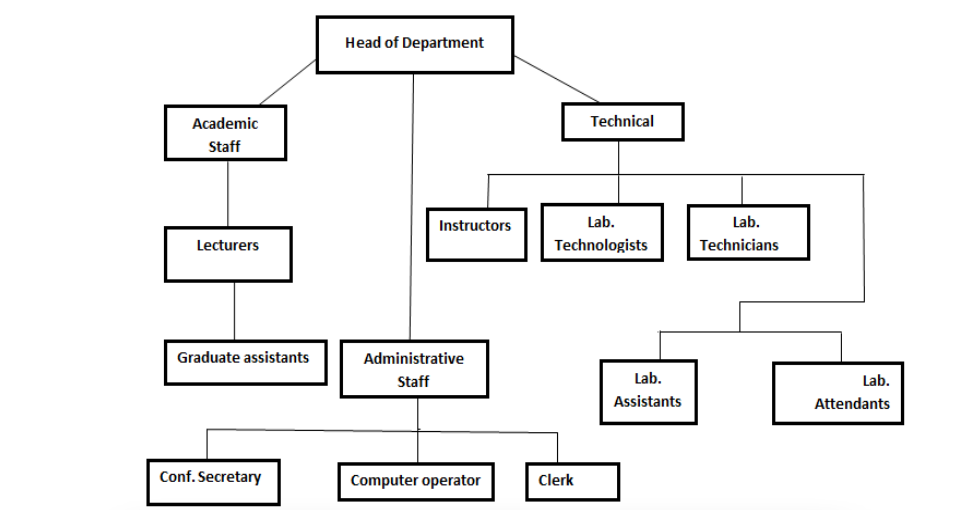
Organogram/Organizational Structure Of The Department
ACADEMIC PROGRAMMES
The Department runs a programme(s) that lead to the award of Bachelor of Technology (B.Tech.), Postgraduate Diploma (PGD), Master of Technology (M.Tech.) and Doctor of Philosophy (Ph.D.) in Chemical/Petrochemical Engineering. The undergraduate programmer(s) is designed to provide fundamental knowledge and then deepen the students’ grasp of Chemical/Petrochemical Engineering principles. It also introduces them to the techniques and tools of research, develops in them the spirit of enquiry and generally prepares them to face challenges and solve problems in the field of Chemical/Petrochemical Engineering.
PHILOSOPHY OF THE DEPARTMENT
Chemical Engineering applies basic scientific principles to design, manufacture, operate and control of chemical process equipment, for the processing of raw materials into economically desired finished products, as well as to the management of the human and material resources necessary for these activities
Profile Of Current Head Of Department
Emmanuel Odianyegbuhua Ehirim is a distinguished scholar and professional engineer in the field of Chemical Engineering Processes. He obtained his Engineering degrees both from the Rivers State University of Science and Technology (RSUST) now Rivers State University (RSU) and the Federal University of Sao Carlos, Sao Carlos, Brazil where he obtained his Masters and Doctor of Philosophy both in Chemical and Petrochemical Engineering.
Professor E. O. Ehirim is currently the Head of Department of Chemical and Petrochemical Engineering and at the Post Graduate level, he teaches Numerical Methods and Analysis and Research Methods and Skills. At the undergraduate level, he lectures: Introduction to Chemical Engineering and Chemical Engineering Technology.
He has served the Faculty of Engineering and the Department in several Administrative capacities including: secretary of the Faculty of Engineering Postgraduate Programme (a role he held for over five years) and Postgraduate Cordinator of the Department of Chemical and Petrochemical Engineering.
With over fifteen years of industrial experience, Professor E. O. Ehirim worked as a Process Engineer at the then National Fertilizer Company of Nigeria (NAFCON) Limited now Notore Chemical Industries Plc where he contributed significantly to the startup of the Urea plant following advanced training with Stami-Carbon BV in Netherlands.
Professor E. O. Ehirim is a registered Professional Engineer with the Council for the Regulation of Engineering in Nigeria (COREN). He is also a member of the Nigerian Society of Engineers (NSE), and the Nigerian Society of Chemical Engineers (NSChE), Rivers/Bayelsa Chapter where he currently serve as the Vice Chairman. His research interest include:
- Mathematical modelling of Chemical Processes
- Electrochemical reactors for industrial effluent treatment
- Bioremediation of hydrocarbon-polluted environments
- Design and optimization of chemical engineering processes
Professor E. O. Ehirim is committed to advancing knowledge in Chemical and Petrochemical Engineering, mentoring young engineers and contributing to industrial and environmental sustainability through research and innovation. He has Numerous Publications. He is happily married and blessed with three children.
Staff Data
Name | Rank | Area of Specialization | Email Engr. Prof. E. O. Ehirim | Professor/HOD | Modelling, Simulation, Numerical method and control | [email protected] Engr. Prof. M. F. N. Abowei | Professor | Chemical Engineering | [email protected] Engr. Prof. E. N. Wami (Contract) | Professor | Reaction Engineering, Chemical Engineering Designs, Unit Operations | [email protected] Prof. J. G. Akpa | Professor | Reaction Engineering, Modelling and Simulation of chemical engineering processes | [email protected] Prof. (Mrs) F. T. Ademiluyi | Professor | Modelling and Simulation of Heat and Mass Transfer, Chemical Engineering Thermodynamics Processes | [email protected] Engr. Prof. A. A. Ujile | Professor | Process Designs of Chemical Engineering, Corrosion Engineering, Mass Transfer Processes | [email protected] Engr. Prof. C. P. Ukpaka | Professor | Biochemical Engineering | [email protected] Engr. Prof. Kenneth K. Dagde | Professor | Unit Operations, Modelling and Simulation of Chemical Engineering Processes | [email protected] Engr. Prof. A. A. Wordu (R17,278) | Professor | Reaction engineering and Reaction Kinetics | [email protected] Engr. Dr. (Mrs) P. N. Ikenyiri | Reader | Unit Operations and Environmental Pollution | [email protected] Engr. Dr. T. O. Goodhead | Reader | Reaction Engineering | [email protected] Engr. Dr. V. O. Izionworu | Reader | Polymer Technology and Process Safety | [email protected] Engr. Dr. (Mrs.) G. O. Chie-Amadi | Senior Lecturer | Chemical Seperation processes and environmental engineering | [email protected] Engr. Dr. C. Aseibichin | Senior Lecturer | Chemical Engineering | [email protected] Engr. Dr. T. N. Amadi | Senior Lecturer | Chemical Engineering | [email protected] Engr. Dr. (Mrs.) K. Bene Chinwah | Senior Lecturer | Environmental/Chemical Engineering | [email protected] Engr. Dr. (Mrs.) I. Altraide | Senior Lecturer | Environmental/Chemical Engineering | [email protected] Engr Dr. I Igwe | Senior Lecturer | Chemical and Petroleum Engineering | [email protected] Engr. Dr. F. O. Wopara | Senior Lecturer | Heat and Mass Transfer | [email protected] Engr. Dr. E. O. Chuku | Lecturer I | Biochemical Engineering | [email protected] Engr. Precious I. Okechukwu | Lecturer II | Modelling and Simulation | [email protected] Engr. Yiga Francis (R67,635) | Lecturer II | Modelling, Simulation and Control | yiga.francis@ ust.edu.ng Engr. Judi-Cata Agbara (R66,325) | Lecturer II | Chemical Engineering | [email protected] Engr. K. C. Okwu (R69,044) | Lecturer II | Chemical Engineering | [email protected] Engr. H. O. Chioma (R66,533) | Lecturer II | Chemical Engineering | [email protected] Engr. C. Chindah (R73,597) | Lecturer II | Chemical Engineering | [email protected] Dr. Mrs. L. N. Nwiabu | Assistant Lecturer | Chemical Engineering | [email protected] Engr. Dr. K. M. Umah (R6257 ET) | Chief Technologist (Head of Lab) | | [email protected] Mr. I. N. C. Munonye | Principal Technologist | | [email protected] Mr. Chinyere Amadi | Technologist I | | [email protected] Engr. (Mrs) J. O Chuku | Technologist I | | [email protected] Mr. O. C. Tasie | Technologist I | | [email protected] Engr. (Mrs) K. D. Chukwuigwe | Technologist I | | [email protected] Mr. L. Owunna | Technologist I | | [email protected] Engr. (Mrs.) G. Charles-Orji | Technologist I | | [email protected] Mr. K. A. Johnson | Technologist II | | [email protected] Mr. O. E. Enyi | Technologist II | | [email protected] Engr. O. H. Ekine | Technologist II | | Engr. V. N. Iwowari | Technologist II | | [email protected] Mr. E. C. Kinika | Technologist II | | [email protected] Engr. T. Ekem | Technologist II | | [email protected] Engr. Mrs. D. N. Tasie | Technologist II | | [email protected] Mr. K. J. Wagwu | Technologist II | | Mr. U. A. Okpu | Technologist II | | Mr. C. Chidi | Lab. Technician | | [email protected] Mrs. O. Owhondah | Lab. Technician | | [email protected] Mr. N. C. Amadi | Lab. Technician | | [email protected] Mr. M. I. Akah | Lab. Assistant | | Mr. O. B. Chinda | Lab. Assistant | | Engr. A. Chimankpam | Lab. Assistant | | Miss. O. H. Ibuchi | Lab. Assistant | | Mrs. Fegebari P. S. | Principal Confidential Sec II | | [email protected] Mr. J. T. Odinaka | Admin II | | Mrs O. M. Addah | Admin II | | Mr E. G. Musa | Messenger | | Mr A. I. J. Buduka | Messenger | |
ACHIEVEMENTS OF THE DEPARTMENT
Research and Consultancy
The Department has been involved in a variety of research programmes. The number of research publications of staff has increased tremendously over the years and the Department to date has produced 10 Professors: Prof. K. I. Idoniboye of blessed memory, Prof. M. F. N Abowei, Prof. E.N. Wami, Prof. S.A. Amadi, Prof. Y.T. Puyate of blessed memory, Prof. (Mrs) F.T. Ademiluyi, Prof. A.A. Ujile, Prof. C.P. Ukpaka, Prof. J.G. Akpa and Prof. K.K. Dagde.
Rehabilitation of Chemical/Petrochemical Engineering Laboratory Equipment
The following companies participated in the rehabilitation of the Chemical/Petrochemical Engineering laboratory equipment: Cupco Engineering Nigeria Limited; Nigeria Local Content and Jospaka Ventures Nigeria Limited.
Nigerian University Commission (NUC) and Council for Regulation of Engineering in Nigeria (COREN) Accreditation
With the support of the Rivers State Government, the University, Corporate Organization, the department is fully accredited by NUC and COREN.
PROSPECTS OF THE DEPARTMENT
- Centre of Excellence for Chemical Engineering processes
- Improve staffing
- Staff and students exchange programmes with other public and private universities in Nigeria, Africa, Europe, the Americas, Asia, and Australia among others.
- Participation of academic staff and non-teaching staff in National and international conferences, workshops, seminar is quite evident. More sponsorship and grants would proffer ample opportunities for more participation.
- Setting up of Gas engineering department
Staffs
| Name | Role | Rank / designation | Area of expertise | |
|---|---|---|---|---|
| Dr. Mrs. L. N. Nwiabu | Assistant Lecturer | Assistant Lecturer | Chemical Engineering | [email protected] |
| Engr Dr. I Igwe | Senior Lecturer | Senior Lecturer | Chemical and Petroleum Engineering | [email protected] |
| Engr. (Mrs) J. O Chuku | Technologist I | Technologist I | — | [email protected] |
| Engr. (Mrs) K. D. Chukwuigwe | Technologist I | Technologist I | — | [email protected] |
| Engr. (Mrs.) G. Charles-Orji | Technologist I | Technologist I | — | [email protected] |
| Engr. A. Chimankpam | Lab. Assistant | Lab. Assistant | — | — |
| Engr. C. Chindah (R73,597) | Lecturer II | Lecturer II | Chemical Engineering | [email protected] |
| Engr. Dr. (Mrs) P. N. Ikenyiri | Reader | Reader | Unit Operations and Environmental Pollution | [email protected] |
| Engr. Dr. (Mrs.) G. O. Chie-Amadi | Senior Lecturer | Senior Lecturer | Chemical Seperation processes and environmental engineering | [email protected] |
| Engr. Dr. (Mrs.) I. Altraide | Senior Lecturer | Senior Lecturer | Environmental/Chemical Engineering | [email protected] |
| Engr. Dr. (Mrs.) K. Bene Chinwah | Senior Lecturer | Senior Lecturer | Environmental/Chemical Engineering | [email protected] |
| Engr. Dr. C. Aseibichin | Senior Lecturer | Senior Lecturer | Chemical Engineering | [email protected] |
| Engr. Dr. E. O. Chuku | Lecturer I | Lecturer I | Biochemical Engineering | [email protected] |
| Engr. Dr. F. O. Wopara | Senior Lecturer | Senior Lecturer | Heat and Mass Transfer | [email protected] |
| Engr. Dr. K. M. Umah (R6257 ET) | Chief Technologist (Head of Lab) | Chief Technologist (Head of Lab) | — | [email protected] |
| Engr. Dr. T. N. Amadi | Senior Lecturer | Senior Lecturer | Chemical Engineering | [email protected] |
| Engr. Dr. T. O. Goodhead | Reader | Reader | Reaction Engineering | [email protected] |
| Engr. Dr. V. O. Izionworu | Reader | Reader | Polymer Technology and Process Safety | [email protected] |
| Engr. H. O. Chioma (R66,533) | Lecturer II | Lecturer II | Chemical Engineering | [email protected] |
| Engr. Judi-Cata Agbara (R66,325) | Lecturer II | Lecturer II | Chemical Engineering | [email protected] |
| Engr. K. C. Okwu (R69,044) | Lecturer II | Lecturer II | Chemical Engineering | [email protected] |
| Engr. Mrs. D. N. Tasie | Technologist II | Technologist II | — | [email protected] |
| Engr. O. H. Ekine | Technologist II | Technologist II | — | — |
| Engr. Precious I. Okechukwu | Lecturer II | Lecturer II | Modelling and Simulation | [email protected] |
| Engr. Prof. A. A. Ujile | Professor | Professor | Process Designs of Chemical Engineering, Corrosion Engineering, Mass Transfer Processes | [email protected] |
| Engr. Prof. A. A. Wordu (R17,278) | Professor | Professor | Reaction engineering and Reaction Kinetics | [email protected] |
| Engr. Prof. C. P. Ukpaka | Professor | Professor | Biochemical Engineering | [email protected] |
| Engr. Prof. E. N. Wami (Contract) | Professor | Professor | Reaction Engineering, Chemical Engineering Designs, Unit Operations | [email protected] |
| Engr. Prof. Kenneth K. Dagde | Professor | Professor | Unit Operations, Modelling and Simulation of Chemical Engineering Processes | [email protected] |
| Engr. Prof. M. F. N. Abowei | Professor | Professor | Chemical Engineering | [email protected] |
| Engr. T. Ekem | Technologist II | Technologist II | — | [email protected] |
| Engr. V. N. Iwowari | Technologist II | Technologist II | — | [email protected] |
| Engr. Yiga Francis (R67,635) | Lecturer II | Lecturer II | Modelling, Simulation and Control | — |
| Miss. O. H. Ibuchi | Lab. Assistant | Lab. Assistant | — | — |
| Mr A. I. J. Buduka | Messenger | Messenger | — | — |
| Mr E. G. Musa | Messenger | Messenger | — | — |
| Mr. C. Chidi | Lab. Technician | Lab. Technician | — | [email protected] |
| Mr. Chinyere Amadi | Technologist I | Technologist I | — | [email protected] |
| Mr. E. C. Kinika | Technologist II | Technologist II | — | [email protected] |
| Mr. I. N. C. Munonye | Principal Technologist | Principal Technologist | — | [email protected] |
| Mr. J. T. Odinaka | Admin II | Admin II | — | — |
| Mr. K. A. Johnson | Technologist II | Technologist II | — | [email protected] |
| Mr. K. J. Wagwu | Technologist II | Technologist II | — | — |
| Mr. L. Owunna | Technologist I | Technologist I | — | [email protected] |
| Mr. M. I. Akah | Lab. Assistant | Lab. Assistant | — | — |
| Mr. N. C. Amadi | Lab. Technician | Lab. Technician | — | [email protected] |
| Mr. O. B. Chinda | Lab. Assistant | Lab. Assistant | — | — |
| Mr. O. C. Tasie | Technologist I | Technologist I | — | [email protected] |
| Mr. O. E. Enyi | Technologist II | Technologist II | — | [email protected] |
| Mr. U. A. Okpu | Technologist II | Technologist II | — | — |
| Mrs O. M. Addah | Admin II | Admin II | — | — |
| Mrs. Fegebari P. S | Principal Confidential Sec II | Principal Confidential Sec II | — | [email protected] |
| Mrs. O. Owhondah | Lab. Technician | Lab. Technician | — | [email protected] |
| Prof. (Mrs) F. T. Ademiluyi | Professor | Professor | Modelling and Simulation of Heat and Mass Transfer, Chemical Engineering Thermodynamics Processes | [email protected] |
| Prof. E. O. Ehirim | Professor/HOD | Professor – Chemical Engineering | General – Engrg. Mathematics Advanced Engrg Mathematics Numerical Methods | [email protected] |
| Prof. Jackson Gunorubon Akpa | Professor | Dean, Faculty of Engineering | Modelling and Simulation of Chemical Engineering Processes; Reaction Engineering; Process Control | [email protected] |